Top 10 CS Platforms in 2026

The Customer Success role is a unique mix of long term thinking and short term operations. It differs from organization to organization and is evolving rapidly with AI.
Similarly, the platforms are rapidly evolving, trying to retrofit AI in their offerings. While in my research scouring through G2, LinkedIn, reddit, I found that almost all modern CS tools basically do the same things:
An all in one 360 view of the entire customer journey, enabled by integrating various data sources
Powerful playbooks and segmentation
Health scores
Some AI sprinkled here and there
They still haven't been able to think through the use cases of Customer Success Managers which can be solved by AI agents like, flagging competitor mentions, auto enriching the CRM, spotting upsell opportunities. This makes the market ripe for innovation and disruption.
But before you jump into evaluating platforms, let's talk about timing.
So, when and how should you onboard a CS tool?
Start simple. You can absolutely make Notion or Google Sheets as a CRM work, while you figure things out.
Get your fundamentals right before even considering a platform. A CS platform is as good as the data you put into it. Then map out,
Your customer success journey stages, goals, and tasks
Figure out how you'll score account health and flag at-risk customers
Find what product metrics actually matter in the context of your company
Draft basic playbooks for common scenarios
Map out how you forecast renewals and define upsell opportunities
Platform Comparison Table
Platform | Known For | Best Suited For | Pricing | Implementation Time |
|---|---|---|---|---|
HQ1 | AI-native platform with swarm of configurable AI agents, pre-built templates | Mid-market to enterprise with high-touch engagement | On request | 4-10 days |
Planhat | Beautiful, highly customizable interface; exceptional support team | Mid-market and enterprise with dedicated CS Ops teams | $60k-$180k/year | Varies |
Vitally | Plug-and-play setup; strong product usage focus for PLG companies | Small to mid-market product-led growth teams | On request | 2-4 weeks |
Pylon | Exceptional Slack integration; fast-shipping product team | Small to mid-market with Slack-centric workflows | ~$100/seat/month + AI add-ons | 1-3 weeks |
Gainsight | Enterprise heavyweight; comprehensive features and deep customization | Large enterprises with dedicated CS Ops teams | $100k+/year | 3-6 months |
ChurnZero | Best-in-class playbook functionality; exceptional support | Mid-market seeking powerful automation | $28k-$75k/year | 3 months |
Custify | Deep customization in segmentation and health scoring; agile support | Mid-market needing flexibility without enterprise complexity | $20k-$60k/year | 4-8 weeks |
Totango/Catalyst | Strong Salesforce integration; pre-built success playbooks | Mid-market to enterprise Salesforce-centric companies | $50k-$150k/year | 2-4 months |
ClientSuccess | Affordable, straightforward platform; quick deployment | Small to mid-market with straightforward CS needs | $8k-$34k/year | 2-4 weeks |
Zapscale | Strong predictive analytics; early churn risk and growth opportunity flagging | Small to mid-market data-driven teams | On request | 3-6 weeks |
HQ1
HQ1 is an AI-native all-in-one customer success and sales enablement platform built on the premise that AI will blur traditional role boundaries. The platform envisions CSMs not just managing post-sales relationships but also supporting Account Executives during demos, while SDRs continuously refine their ICP understanding.
Key Features
Swarm of AI Agents - HQ1's configurable AI agents enable sophisticated workflows including:
Auto-populating CRM fields from sales conversations
Analyzing objections and patterns from won/lost deals
Training new AEs and CSMs using best-performing conversations and internal playbooks
Predicting churn using product usage signals and customer sentiment
Highlighting accounts at risk or ready for expansion
Detecting competitor mentions across calls, emails, and tickets to maintain competitive awareness
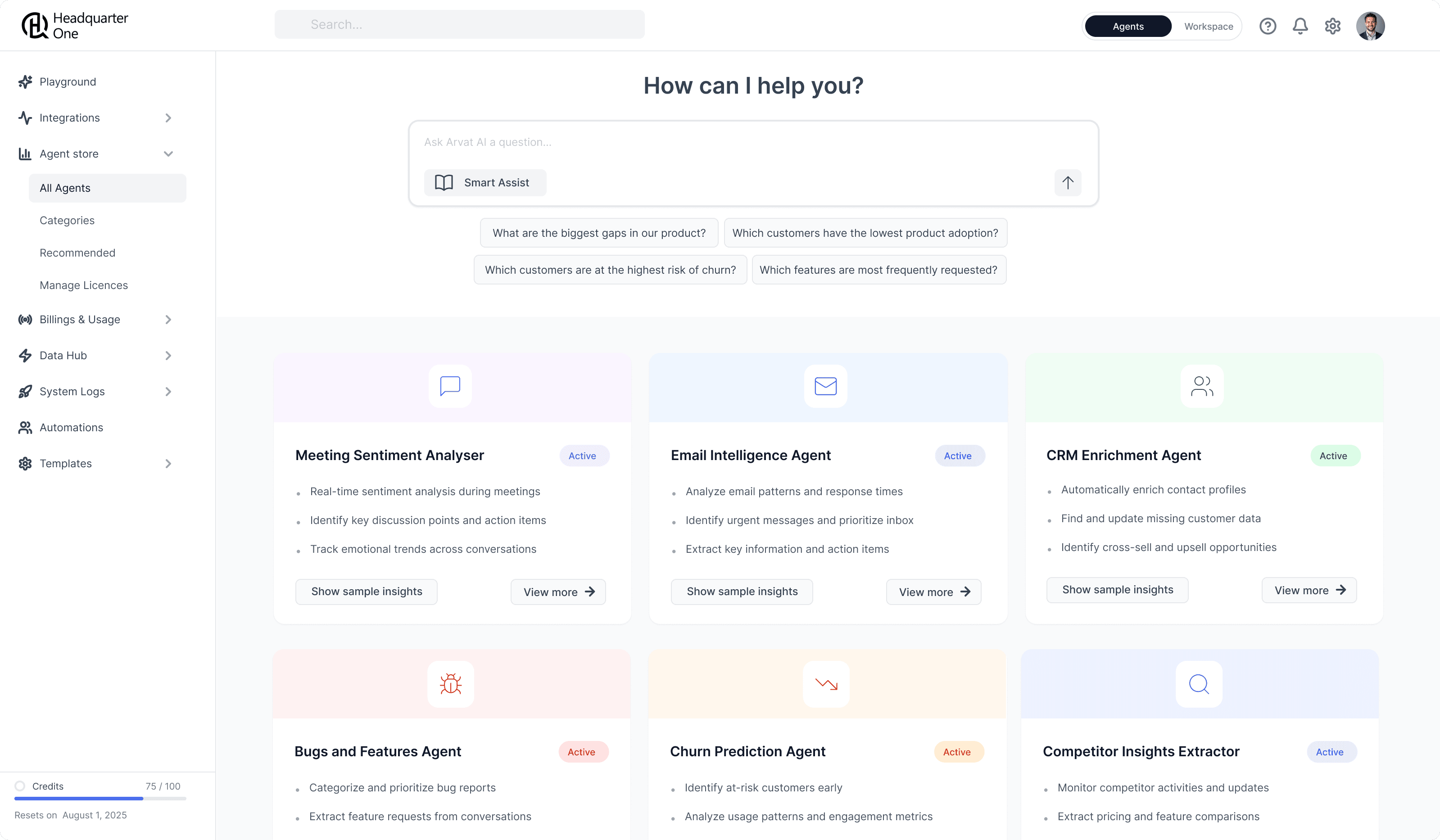
Robust Integrations - The platform connects with CRMs, ticketing systems, payment processors, meeting note-takers, calendars, custom databases, and Excel to create a unified data layer that powers the AI agents.
Pre-built Templates - Customer success best practices are encapsulated in ready-to-use templates for playbooks, segmentation, and AI agent configurations, accelerating implementation.
360° Customer Journey View - Customizable dashboards consolidate revenue details, invoices, emails, meetings, product usage trends, tasks, and tickets, enabling seamless collaboration across RevOps, Sales, Customer Success, and Product teams.
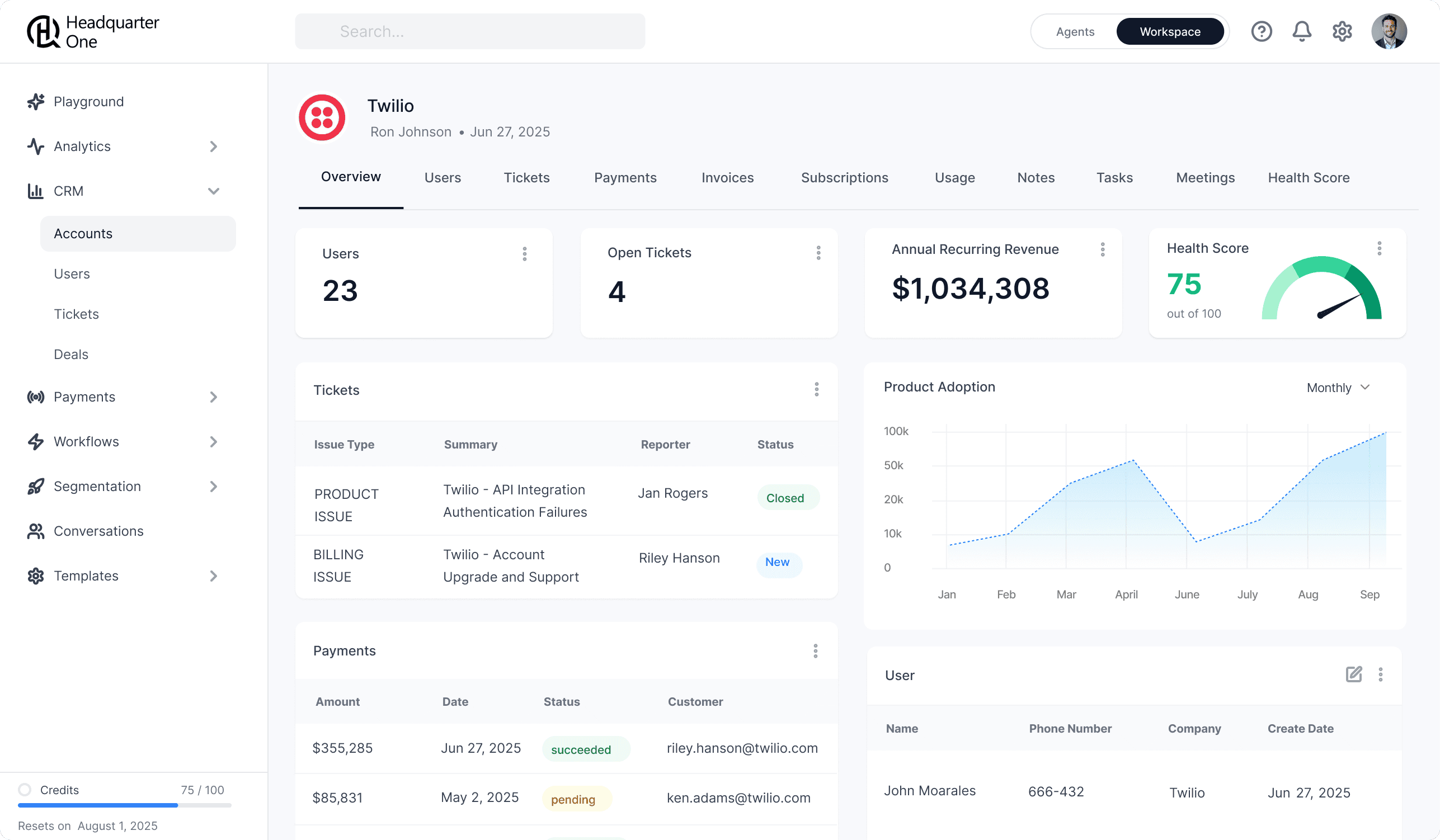
Powerful Playbooks - Automated workflows handle critical processes like sales-to-CS handoffs, churn prevention triggers when health scores decline, and AI agent orchestration.
Advanced Segmentation - Filter customers by revenue, region, health score, product adoption metrics, and other custom criteria.
Nuanced Health Scoring - The platform combines product usage data, ticket volume, invoice patterns, and AI-generated insights to create sophisticated health scores that can be customized for different customer segments.
Ideal for: Mid-market to enterprise companies with high-touch customer engagement models
Implementation time: 4-10 days
Pricing: Available on request
Planhat
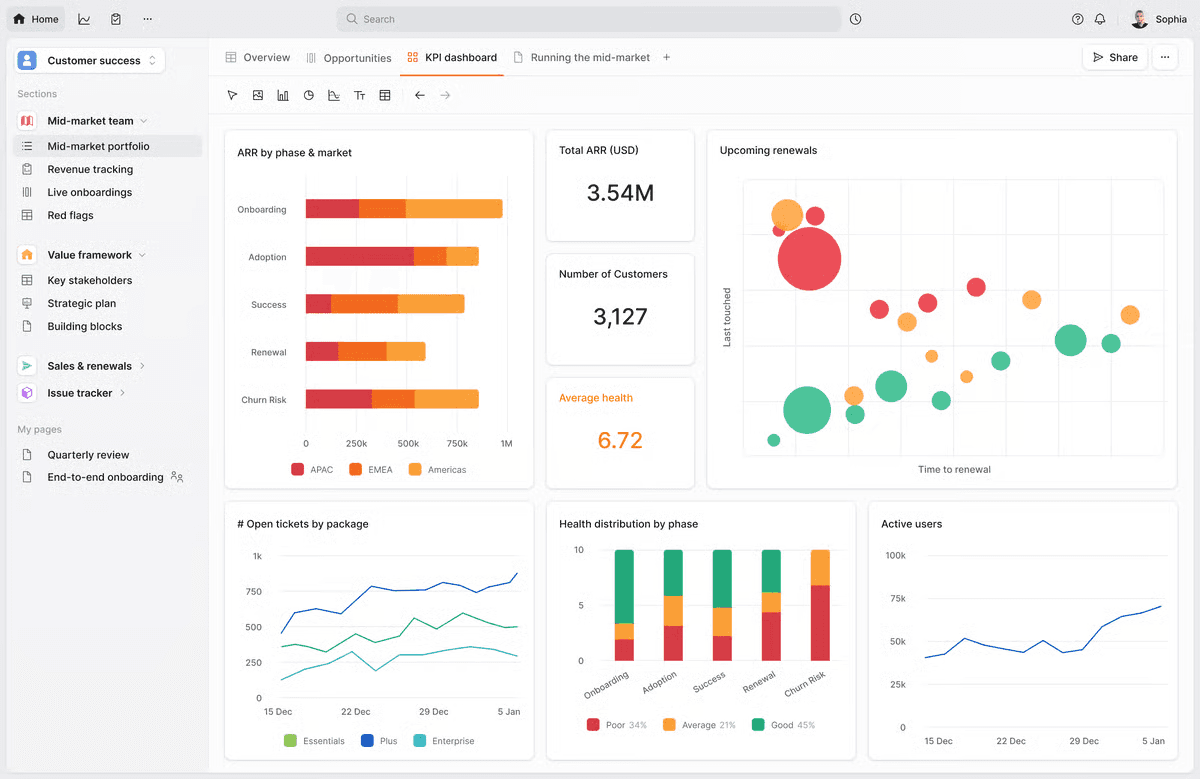
Planhat is known for its beautiful, highly customizable interface and exceptional support team. It's best suited for mid-market and enterprise companies with dedicated CS Ops teams who can leverage its extensive customization — though this flexibility can make onboarding overwhelming without the right resources.
Strengths
Unified Customer Intelligence: Planhat consolidates usage data, health metrics, revenue insights, and engagement patterns into a single platform, eliminating data silos.
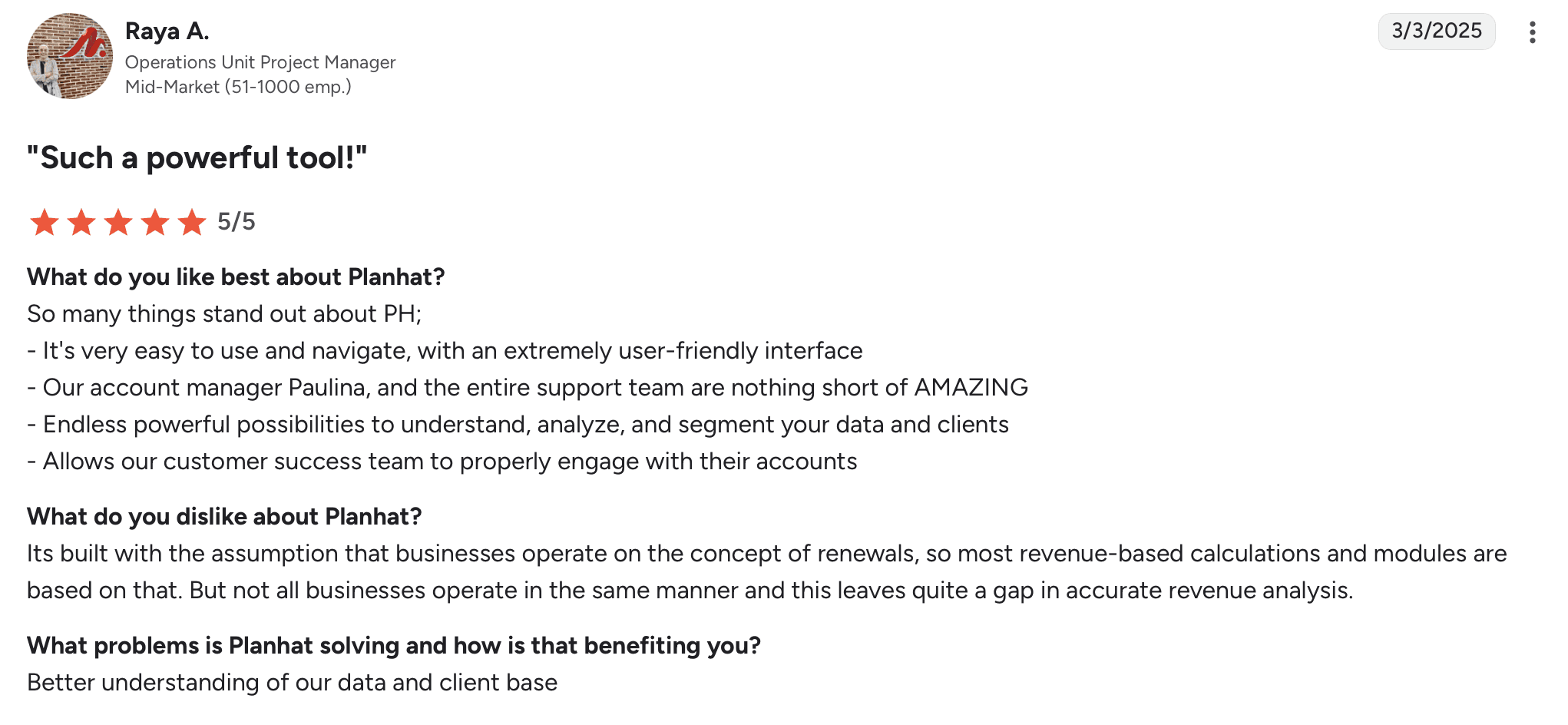
Exceptional Support: Users consistently praise Planhat's customer success and support teams for their responsiveness and expertise.
Beautiful, Intuitive UI: The platform delivers a sleek, modern interface that feels fresh and easy to navigate.
Highly Customizable: Teams can tailor screens and dashboards to specific segment requirements and team workflows, though this flexibility comes with tradeoffs.
Product Usage Tracking: Clear insights into user login activity and feature adoption provide valuable signals for early warning systems.
No Per-Seat Pricing: While Planhat's overall pricing is premium, the lack of per-seat fees prevents exponential cost scaling as teams grow.
Weaknesses
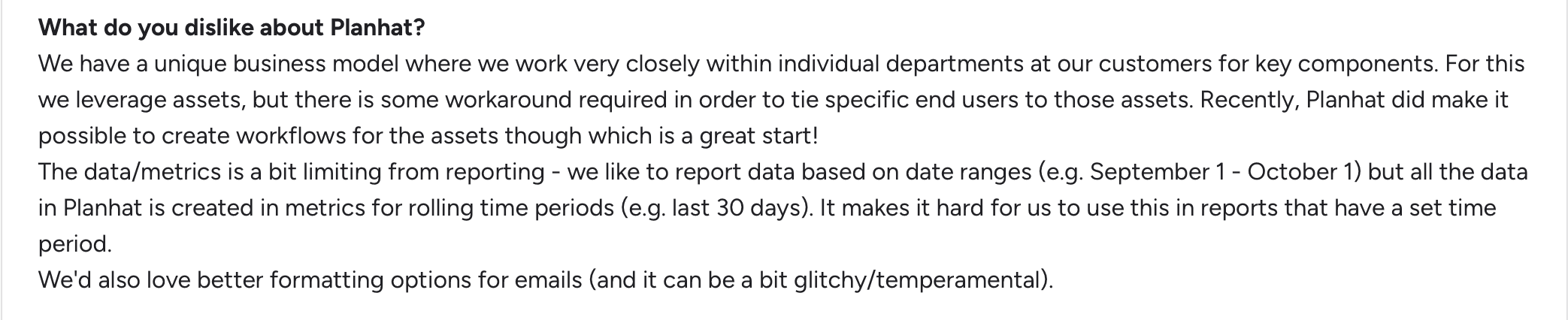
No Built-in Forms: Some users have noted the absence of native form functionality, requiring workarounds or third-party integrations.
Premium Pricing: Planhat sits on the higher end of the pricing spectrum compared to competitors.
Overwhelming Onboarding: The extensive customization options, while powerful, can make initial setup feel daunting without dedicated resources.
Company-Centric Data Model: Planhat's architecture centers on the Companies object, requiring users to build automations to transfer properties to other objects. Some users have suggested that formula fields could simplify this synchronization.
Inconsistent Documentation: Self-help resources can be hit or miss, with gaps in coverage for certain features.
Performance Issues: Page loading times have reportedly increased with the new UI, particularly for users with large datasets.
Email Formatting Challenges: Some users find the email composition experience within Planhat cumbersome and less intuitive than dedicated email tools.
Ideal for: Mid-market and enterprise companies, especially those with dedicated CS Operations teams who can fully leverage Planhat's customization capabilities.
Pricing: $60k-$180k per year
Implementation time: Varies based on customization needs
Vitally

Vitally is known for being plug-and-play with a strong focus on product usage data and PLG companies. It's best suited for small to mid-market product-led teams where CS collaborates closely with Sales and RevOps, though it lacks enterprise-grade stakeholder mapping and scalability.
Strengths
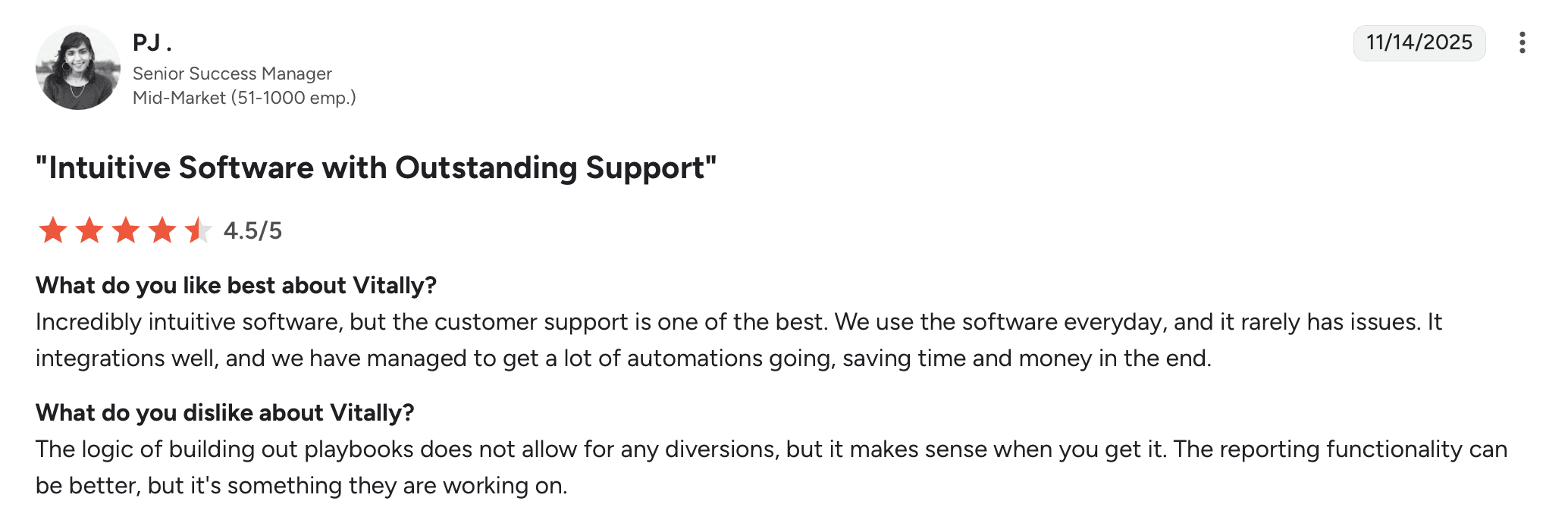
Plug-and-Play Setup: Vitally is known for its ease of implementation, allowing teams to get up and running quickly.
Startup-Friendly Pricing: The platform offers affordable entry points for smaller companies and provides a two-week trial period.
Custom Objects: Users can create custom data objects to track any metrics relevant to their business.
In-App NPS Tool: Built-in Net Promoter Score tracking enables sentiment monitoring without additional tools.
Product-Led Growth Focus: Vitally excels for product usage-focused CS teams that collaborate closely with Sales and RevOps to drive revenue.
Flexible Data Architecture: The ability to define custom objects makes Vitally adaptable to various business models.
Weaknesses
Enterprise Limitations: The platform isn't built to handle the complexity and scale requirements of large enterprise organizations.
Limited Stakeholder Mapping: Some users report that the platform only supports a single account owner per client, which creates challenges for large enterprise accounts with multiple relationship owners and complex org structures.
Steep Learning Curve: Despite its plug-and-play reputation, Vitally can be quite technical, requiring significant time investment to master.
Overpriced AI Features: While the AI capabilities show promise, some users feel the additional cost doesn't justify the outcomes delivered.
Integration Gaps: Although Vitally offers numerous integrations, bi-directional sync functionality is lacking for some core platforms, leading to manual data updates and potential inconsistencies.
Ideal for: Small to mid-market companies with product-led growth models
Pricing: Available on request
Implementation time: 2-4 weeks
Pylon

Pylon stands out for its exceptional Slack integration and fast-shipping product team. Originally built for support, it's best for small to mid-market companies running Slack-centric workflows, though account management features aren't as comprehensive as purpose-built CS platforms. If you are a fast growing startup, Planhat can be a great option
Strengths
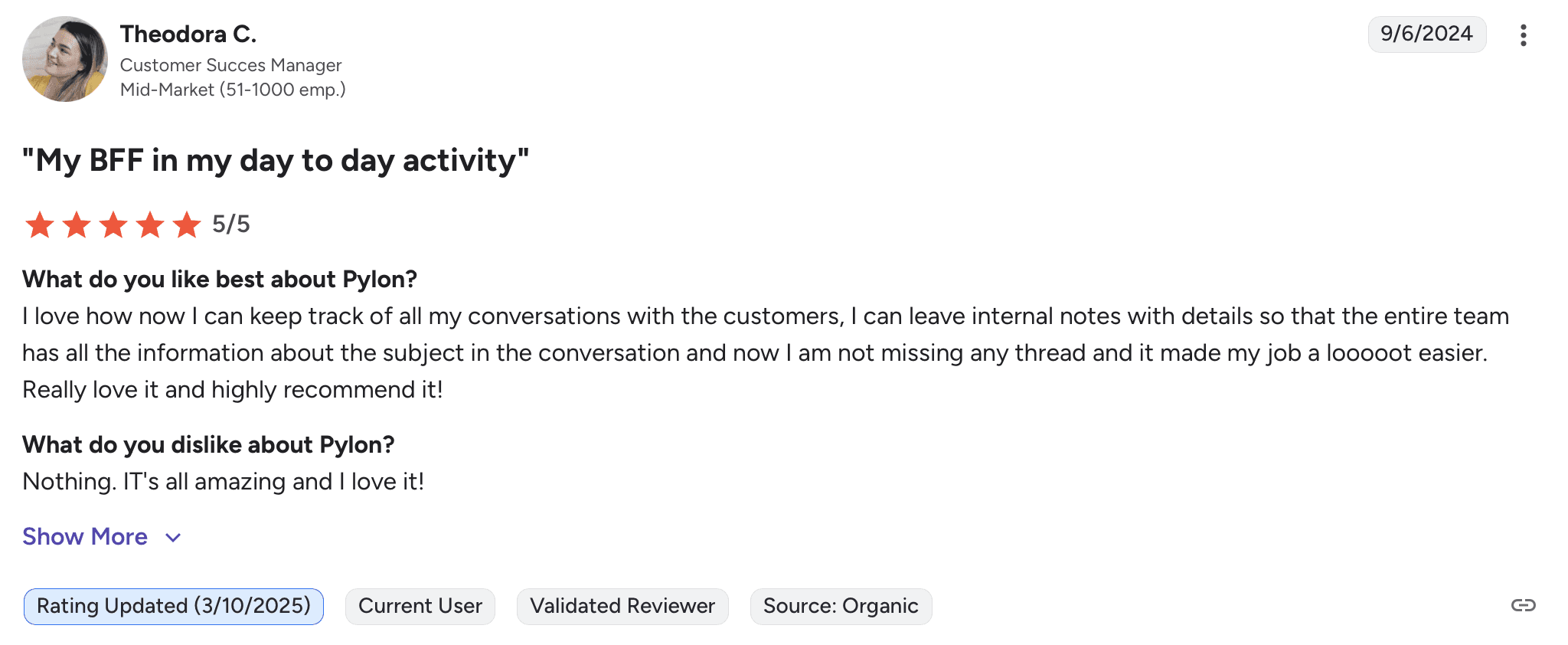
Excellent Support Team: Users consistently highlight the responsiveness and helpfulness of Pylon's customer support.
Robust Slack Integration: The platform shines for teams running support and success processes through Slack.
All-in-One Platform: Pylon consolidates multiple CS functions into a single interface.
Competitive Pricing: Well-funded and offering aggressive pricing to gain market share.
Fast Iteration: The team ships new features rapidly, responding quickly to user feedback.
Intuitive UI/UX: The interface is clean and user-friendly, reducing training time.
Weaknesses
Performance Issues: Some users report UI lag of up to 5 seconds, which can disrupt workflow efficiency during high-volume periods.
Support-First Architecture: While the platform has expanded into account management, some users feel these capabilities aren't as comprehensive as purpose-built CS platforms, as the foundation was originally built for support use cases.
Documentation Gaps: Some users find the documentation incomplete or overly technical for non-technical team members.
Limited Customization: The lack of deep customization options makes Pylon less suitable for enterprises with complex, business-specific requirements.
Integration Limitations: Poor integration with some third-party applications reduces flexibility for teams with diverse tech stacks.
Pricing Model Changes: The product's pricing has evolved multiple times, creating uncertainty. Some users have expressed frustrations that AI features for internal teams are positioned as add-ons rather than being included in seat pricing, making the true cost per seat higher than initially apparent.
Ideal for: Small to mid-market companies with Slack-centric support and success workflows
Pricing: Starting around $100/seat/month (base), with AI features as add-ons
Implementation time: 1-3 weeks
Gainsight
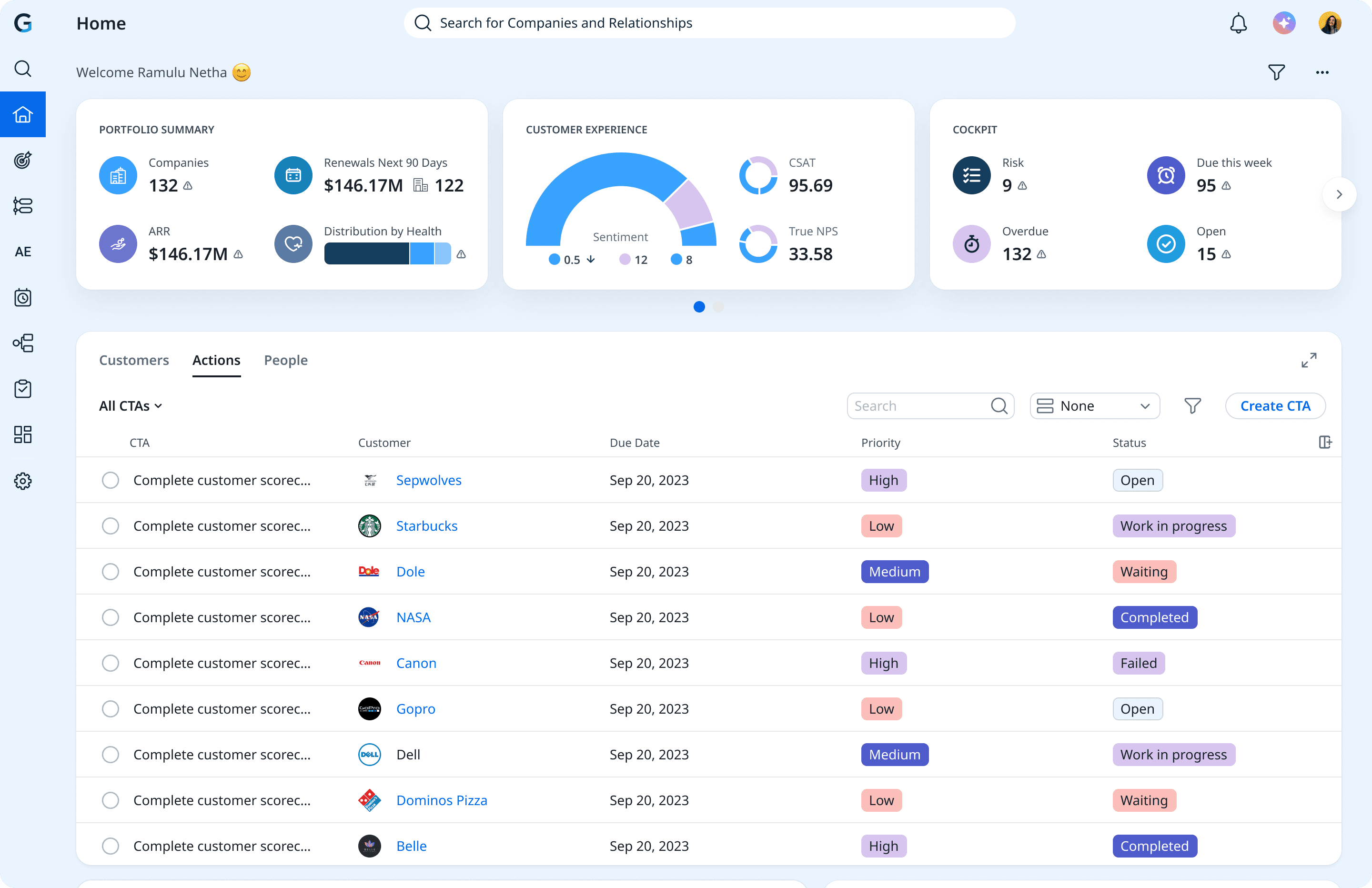
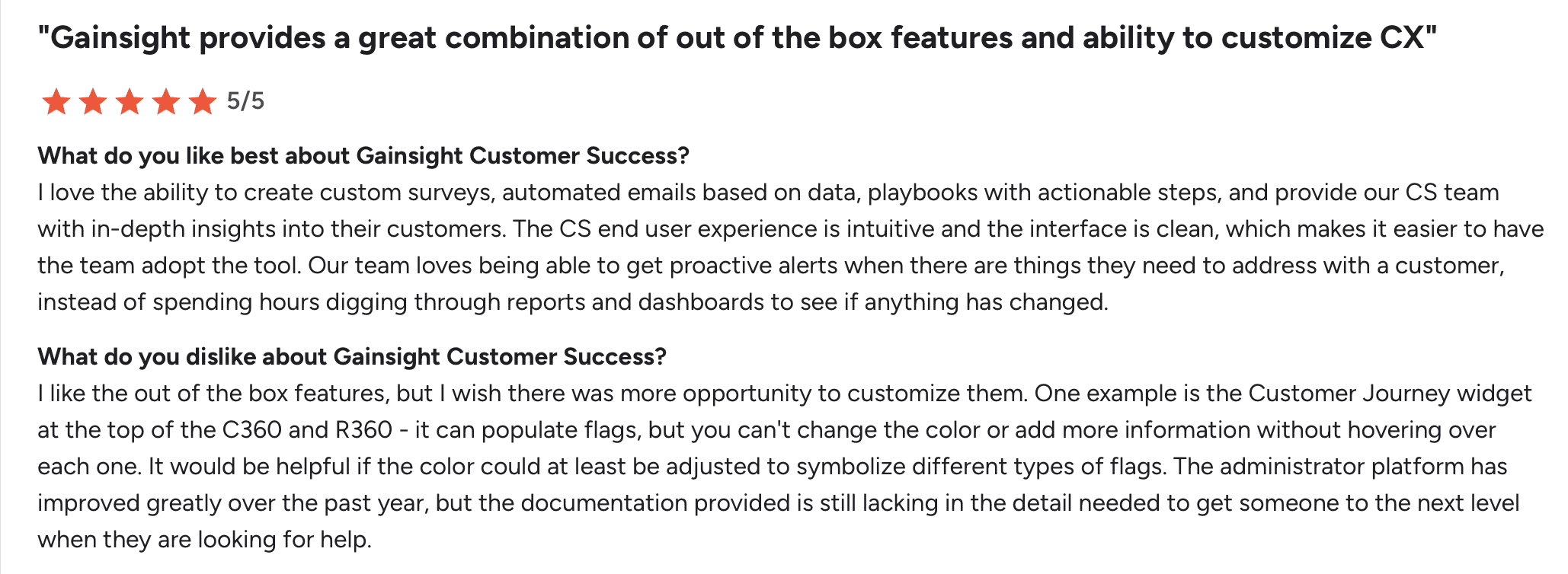
Gainsight is the enterprise heavyweight known for comprehensive features and deep customization. Best for large organizations with dedicated CS Ops teams handling complex customer journeys, though it comes with premium pricing and recent Salesforce integration issues have raised concerns. Their support have also started lagging after they fired a lot of CSM's earlier last year.
Strengths
Highly Customizable: Gainsight offers a comprehensive feature set with deep customization options, making it adaptable to complex organizational needs.
Enterprise Power: When properly implemented with dedicated CS Ops resources, Gainsight becomes incredibly powerful for large organizations managing sophisticated customer journeys.
Strong Community: The Gainsight community provides a vast knowledge base of best practices, with extensive documentation and video resources.
Data Consolidation: The platform excels at bringing together usage data, support cases, meeting notes, and other customer touchpoints in one place.
Mature Platform: Years of development have resulted in deep functionality across all core CS disciplines.
Weaknesses
Salesforce Integration Issues: Some users have reported recent sync problems with Salesforce, reportedly related to security concerns, which can create data inconsistencies.
High-Touch Limitations: The platform doesn't perform optimally for teams with very high-touch, relationship-driven engagement models.
Excessive Pricing: Costs can be prohibitive, especially for mid-market companies.
Data Entry Overhead: Some users feel the platform requires excessive data entry that feels like busy work rather than meaningful customer success activities.
Support Degradation: Following recent workforce reductions, some users report slower support response times and reduced support quality.
Performance Issues: Reports and dashboards can be slow to load, particularly when working with large datasets or complex calculations.
Feature Inconsistency: Users have noted growing lack of parity across platform features like Cockpit and Timeline sync, calculated fields, filters, and API behavior. This inconsistency, combined with what some perceive as insufficient attention to fundamental issues, has raised concerns about the platform's direction.
Ideal for: Large enterprises with dedicated CS Operations teams and complex customer success requirements
Pricing: $100k+ annually (varies significantly based on user count and modules)
Implementation time: 3-6 months
ChurnZero
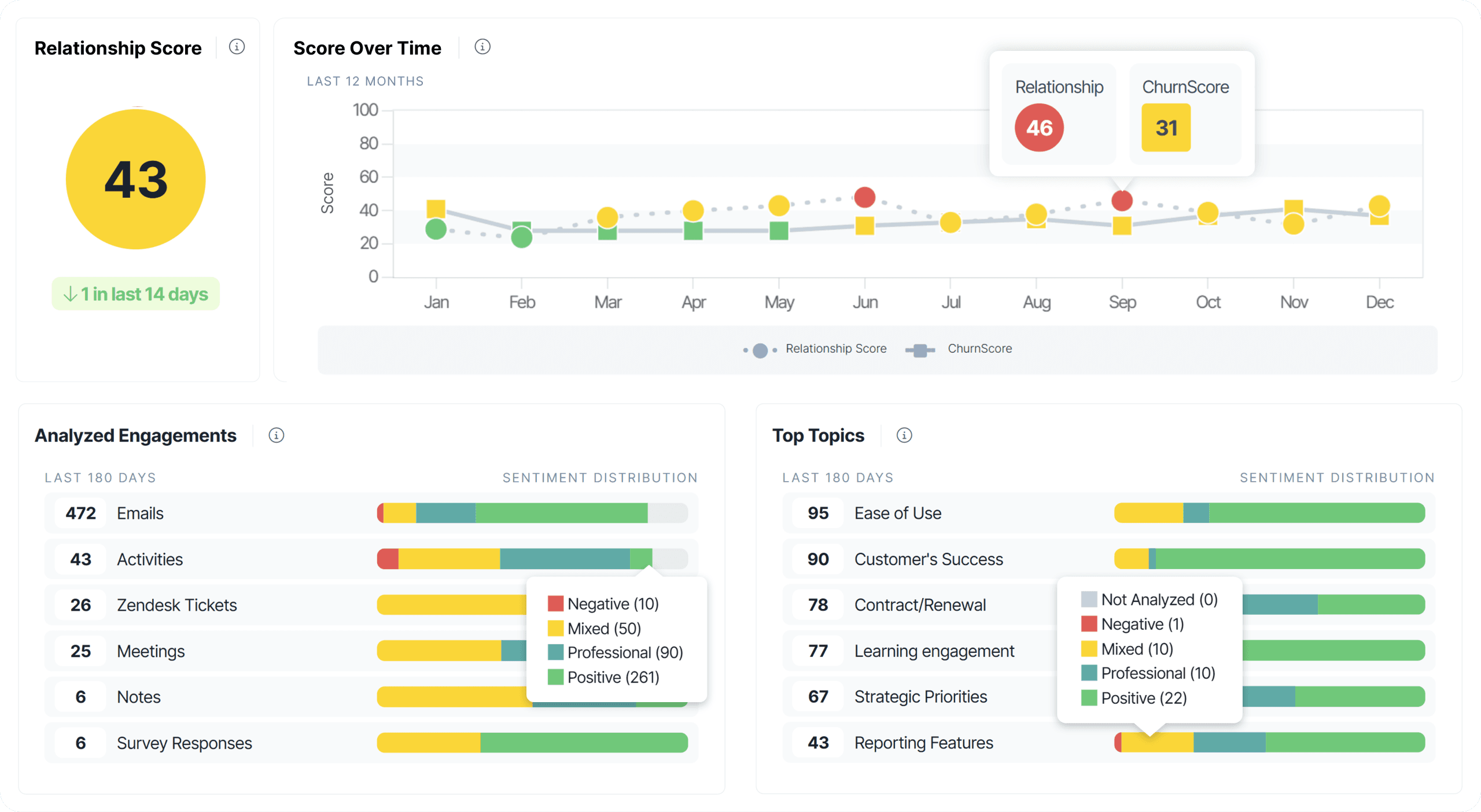
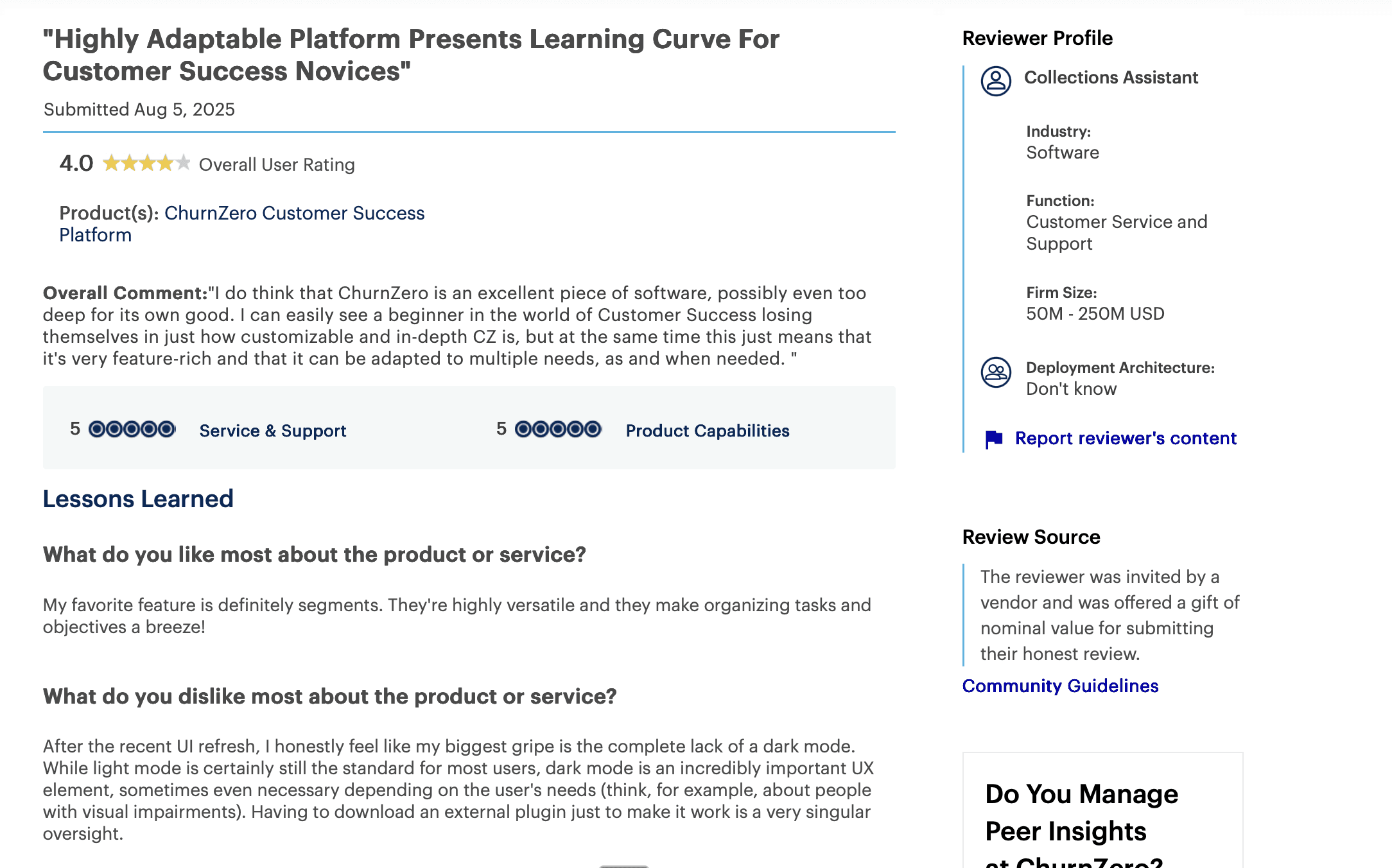
ChurnZero is known for best-in-class playbook functionality and exceptional support. Best suited for mid-market companies seeking powerful automation without enterprise complexity, though the platform's separation of Plays and Journeys creates workflow challenges for building cohesive customer experiences.
Strengths
Exceptional Support: ChurnZero's support team is known for going above and beyond from day one of implementation.
Smooth Implementation: A dedicated implementation team combined with strong processes makes deployment relatively painless.
Intuitive Design: The platform is designed with user experience in mind, making it accessible to team members with varying technical skills.
Flexible Automation: Users can create segments, plays, and journeys tailored to both accounts and contacts, enabling sophisticated automation for emails, account updates, and external sharing with minimal ongoing effort.
Best-in-Class Playbooks: ChurnZero's playbook functionality is widely considered industry-leading, offering exceptional customization while remaining user-friendly.
Comprehensive 360° View: Powerful dashboards provide complete visibility into the customer journey with strong planning and tracking capabilities.
Weaknesses
Fragmented Customer Journeys: The platform separates Plays and Journeys into distinct features with no way to build them cohesively. Users must build journeys separately and then navigate to a different area for automation setup, creating workflow inefficiencies.
Segment Complexity: When creating account-based segments, some users struggle to display all necessary data in a single view. This forces teams to create separate segments based on contacts, opportunities, or cases, making navigation and analysis more difficult.
Complex Reporting: While no-code reporting exists, generating reports with multi-clause criteria can be challenging. Some teams resort to creating multiple smaller reports and manually combining them to apply complex logic.
Limited Report Customization: Out-of-the-box reports lack deep customization options, pushing some teams to export data to Excel for ad hoc analysis.
Bulk Email Limitations: Formatting and sending large volumes of emails can be cumbersome compared to dedicated email platforms.
Ideal for: Mid-market companies seeking strong playbook automation and intuitive design
Pricing: $28k - $75k annually
Implementation time: 3 months
Custify
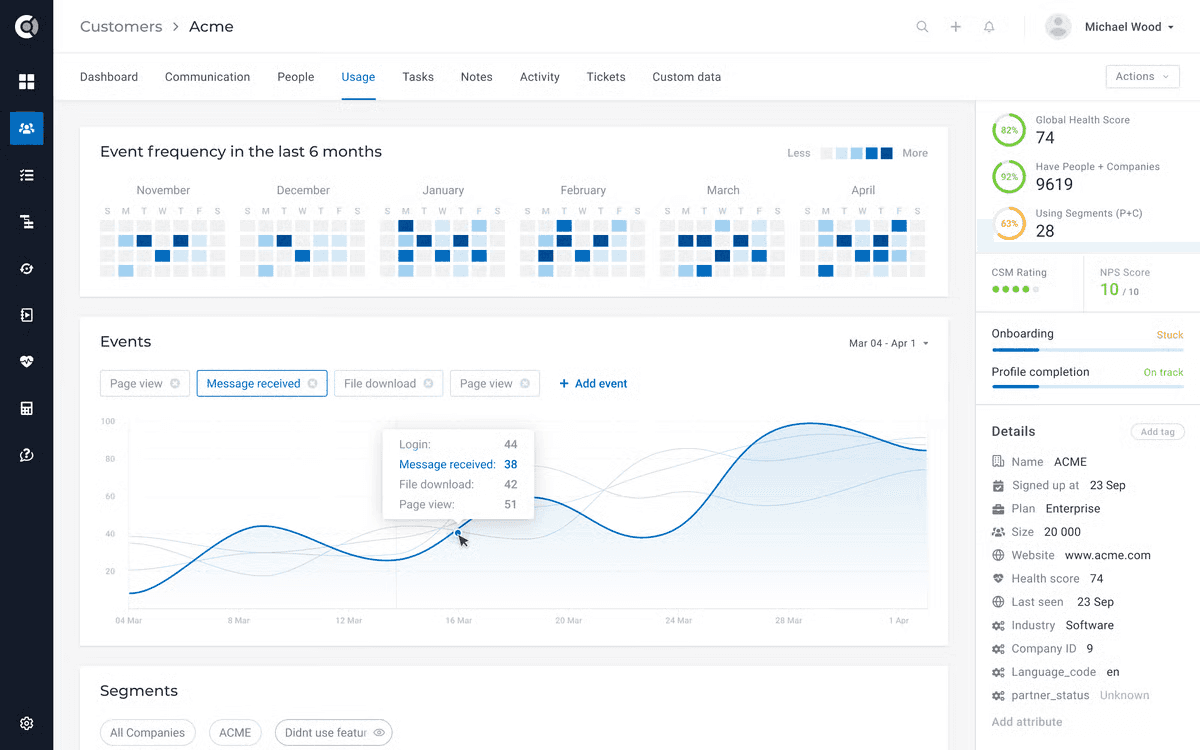
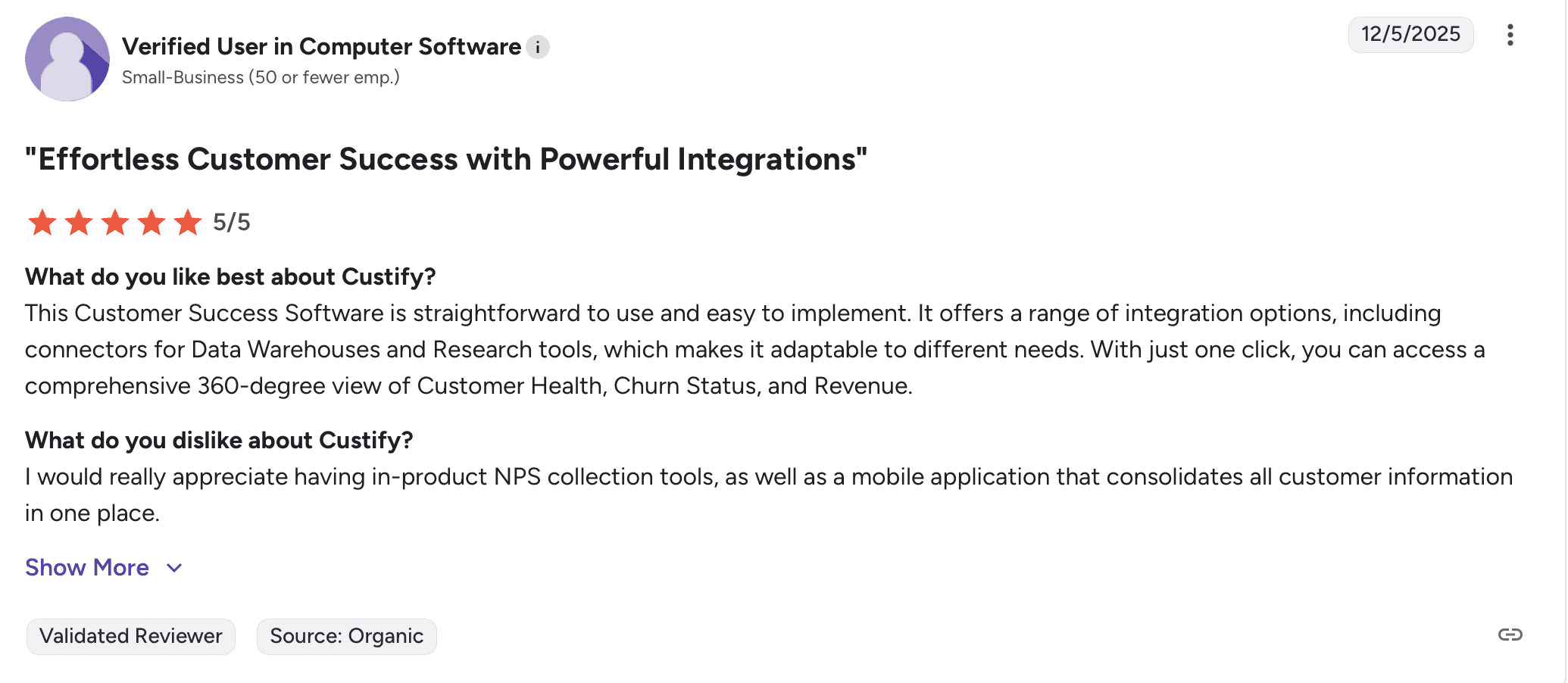
Custify is known for deep customization in segmentation and health scoring with an agile support team. Best suited for mid-market companies needing flexibility without enterprise complexity, though users report documentation gaps and a steeper learning curve than the intuitive UI suggests.
Strengths
Agile Support Team: Users praise Custify's responsive and helpful support team.
Deep Customization: The platform offers extensive customization options, particularly for segmentation and health score configuration.
Diverse Integrations: Custify provides a range of integration options, including connectors for data warehouses and research tools, making it adaptable to different technical environments.
Intuitive UI: The clean interface, combined with a strong support team and knowledge base, enables faster implementation than many competitors.
Flexible Data Model: Users can configure the platform to match their specific business processes without extensive technical resources.
Weaknesses
Steep Learning Curve: Despite the intuitive interface, several users find that fully understanding the platform's numerous features and possibilities takes longer than expected.
Missing Revenue Dashboard: A significant gap is the absence of a global revenue dashboard for tracking overall revenue performance. Users emphasize this feature's importance for gaining at-a-glance insights into business performance.
Documentation Gaps: Certain areas lack clear documentation, particularly around what specific checkboxes or components actually do. The Playbooks module settings, for example, have been cited as lacking clear explanations.
Time Zone Challenges: With support primarily based in EMEA, US-based customers may need to work within limited support hours, though users note this isn't typically a major issue.
Ideal for: Mid-market companies seeking customization without enterprise complexity
Pricing: $20k - $60k annually
Implementation time: 4-8 weeks
Totango/Catalyst
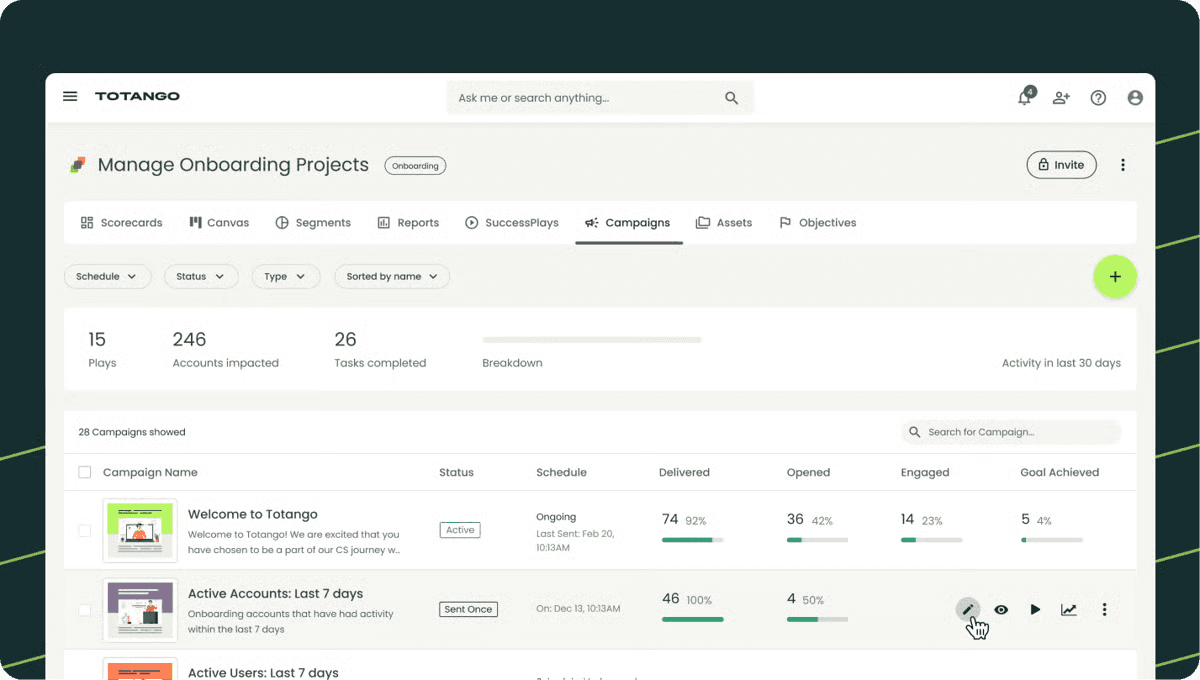
Totango is known for strong Salesforce integration and pre-built success playbooks. Best for mid-market to enterprise Salesforce-centric companies, though users note limited project management tools for complex journeys and concerns about pricing transparency.
Strengths
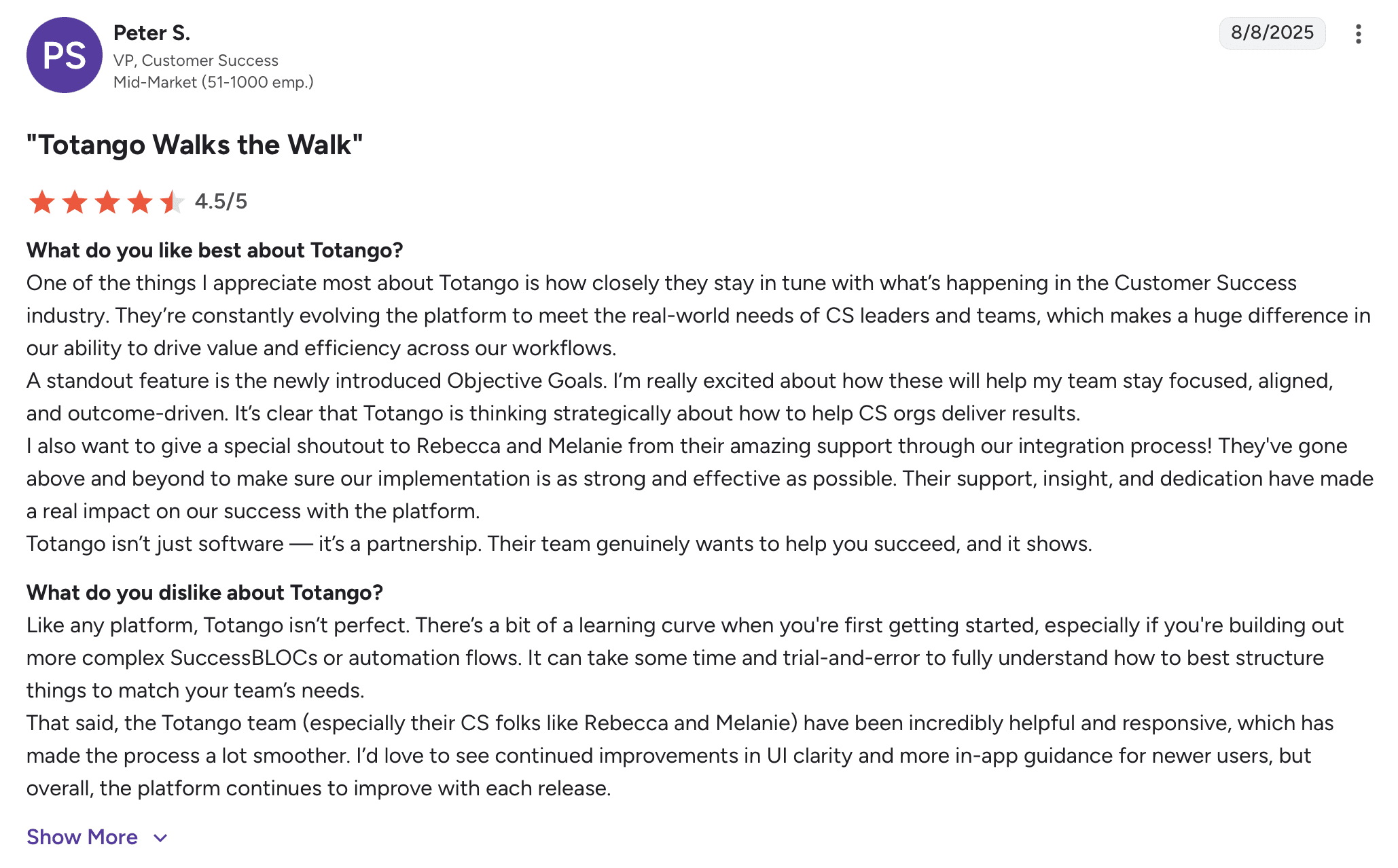
Strong Salesforce Integration: Totango offers one of the most robust Salesforce integrations in the market, making it ideal for Salesforce-centric organizations.
Pre-Built Success Playbooks: Customizable playbooks guide CSMs through proven processes, facilitating consistent and effective customer engagement.
Multi-Channel Communication: The platform supports email, in-app messaging, and SMS for comprehensive customer interaction.
Objective Goals Feature: The recently introduced Objective Goals functionality helps teams stay focused, aligned, and outcome-driven, providing clear visibility into progress against key metrics.
Mature Platform: Years in the market have resulted in stable, well-tested functionality.
Weaknesses
Limited Journey Management: Totango lacks robust tools for managing customer journeys as structured projects. While milestones and tasks exist, they're insufficient for tracking complex onboarding or multi-phase success plans, making cross-team collaboration difficult.
Pricing Opacity: Users have complained about lack of pricing transparency and feeling locked into contracts without adequate support for changing needs.
Account Hierarchy Constraints: The platform isn't ideal for organizations with complex account structures or nested hierarchies.
Reporting Limitations: Some users find the reporting features rigid, lacking the depth needed for sophisticated analysis.
Learning Curve: Initial setup and customization can be challenging, particularly for teams without dedicated CS Ops resources.
Ideal for: Mid-market to enterprise companies deeply integrated with Salesforce
Pricing: $50k - $150k annually
Implementation time: 2-4 months
ClientSuccess
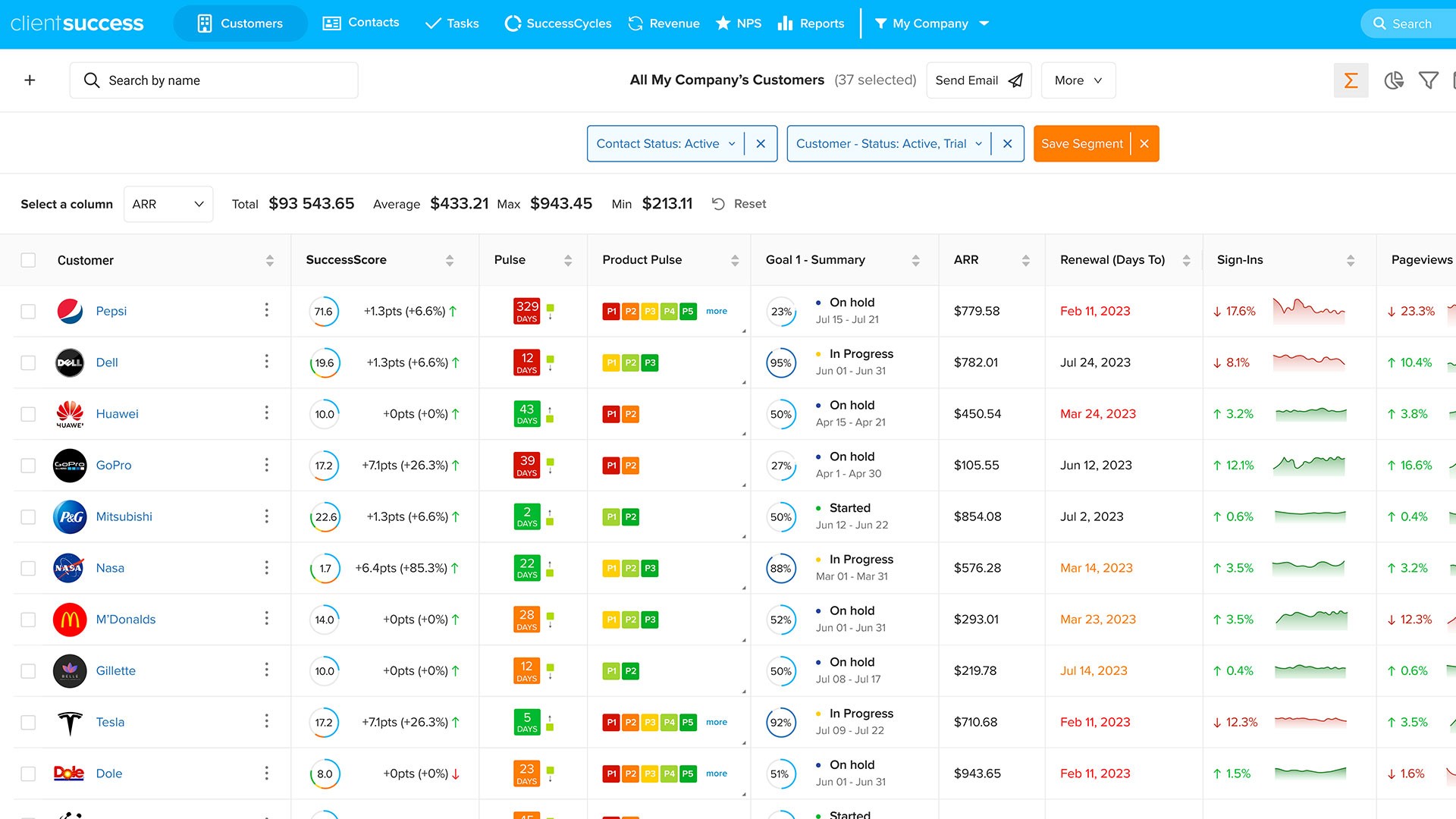
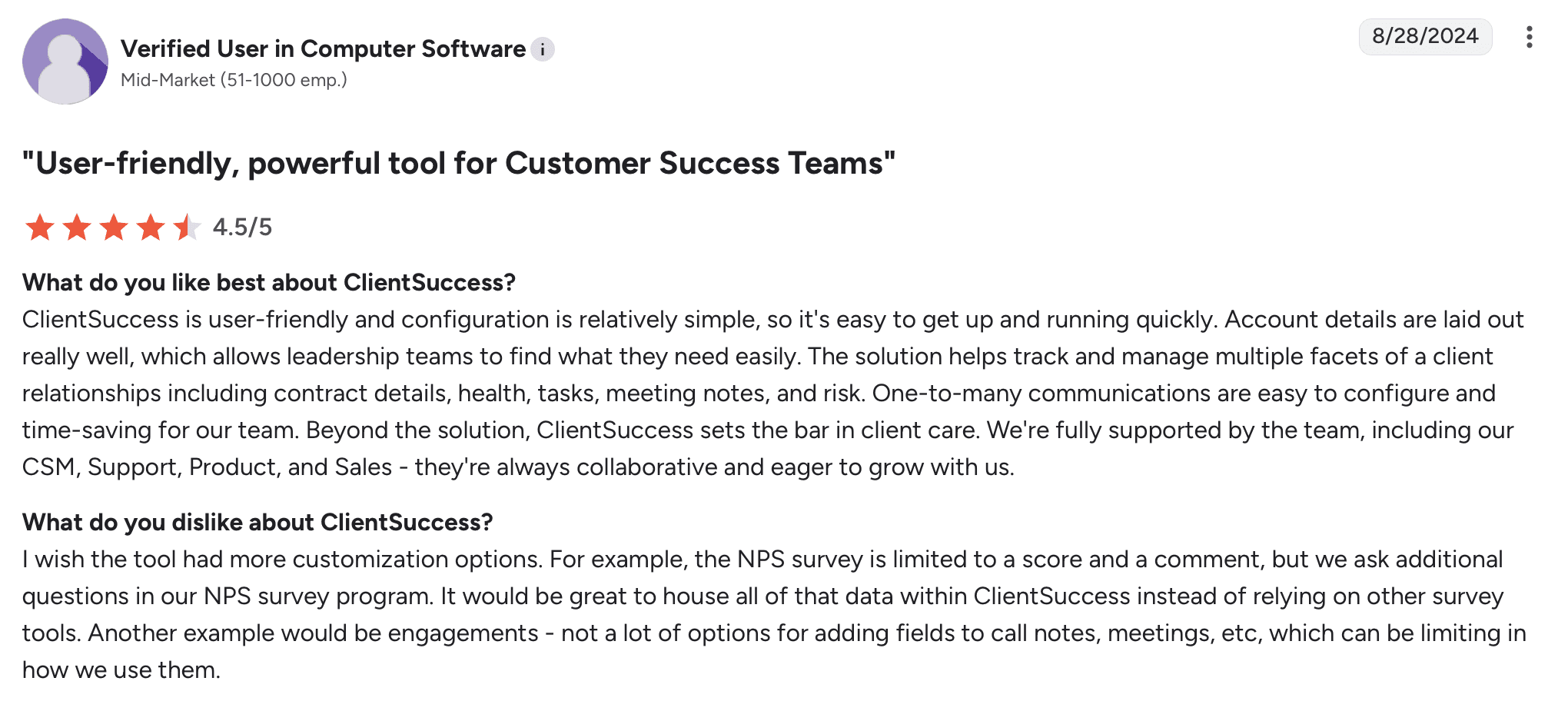
ClientSuccess is known as an affordable, straightforward platform with quick deployment. Best suited for small to mid-market companies valuing simplicity over advanced functionality, with helpful email syncing but limited integrations and customization options.
Strengths
Affordable Pricing: One of the more budget-friendly options on this list, making it accessible for smaller CS teams.
Email Syncing: Communication to and from customers automatically syncs within CS engagements, ensuring continuity when CSMs transition between accounts.
User-Friendly: The platform is easy to navigate, and configuration is relatively simple, enabling teams to get up and running quickly without extensive technical expertise.
Straightforward Implementation: The lack of complexity that limits enterprise use also makes deployment faster and less resource-intensive for smaller teams.
Weaknesses
Scalability Issues: The platform doesn't scale well for enterprise organizations with complex requirements or large customer bases.
Limited Integrations: Compared to competitors, ClientSuccess offers fewer integration options, which can be restrictive for teams with diverse tech stacks.
Customization Constraints: Features like the NPS survey are limited in scope. For example, users can only collect a score and a comment, but cannot add additional custom questions that many NPS programs require.
Basic Feature Set: While simplicity is an advantage for some, teams with sophisticated CS requirements may find the platform lacking in advanced functionality.
Ideal for: Small to mid-market companies with straightforward CS requirements
Pricing: $8k - $34k annually
Implementation time: 2-4 weeks
ZapScale

Zapscale is known for strong predictive analytics that flag churn risks and growth opportunities early. Best for small to mid-market data-driven teams, though recent website issues and employee departures raise concerns, and analytics quality depends heavily on clean data.
Strengths
Unified Customer View: Zapscale consolidates customer data across systems into a single interface.
Easy Setup: The straightforward implementation process and strong support team make adoption smooth and user-friendly.
Strong Predictive Analytics: The platform's predictive capabilities are among its strongest features, effectively flagging churn risks and identifying growth opportunities early.
Workflow Automation: Automated workflows reduce manual effort and minimize tool-switching, improving team efficiency.
Weaknesses
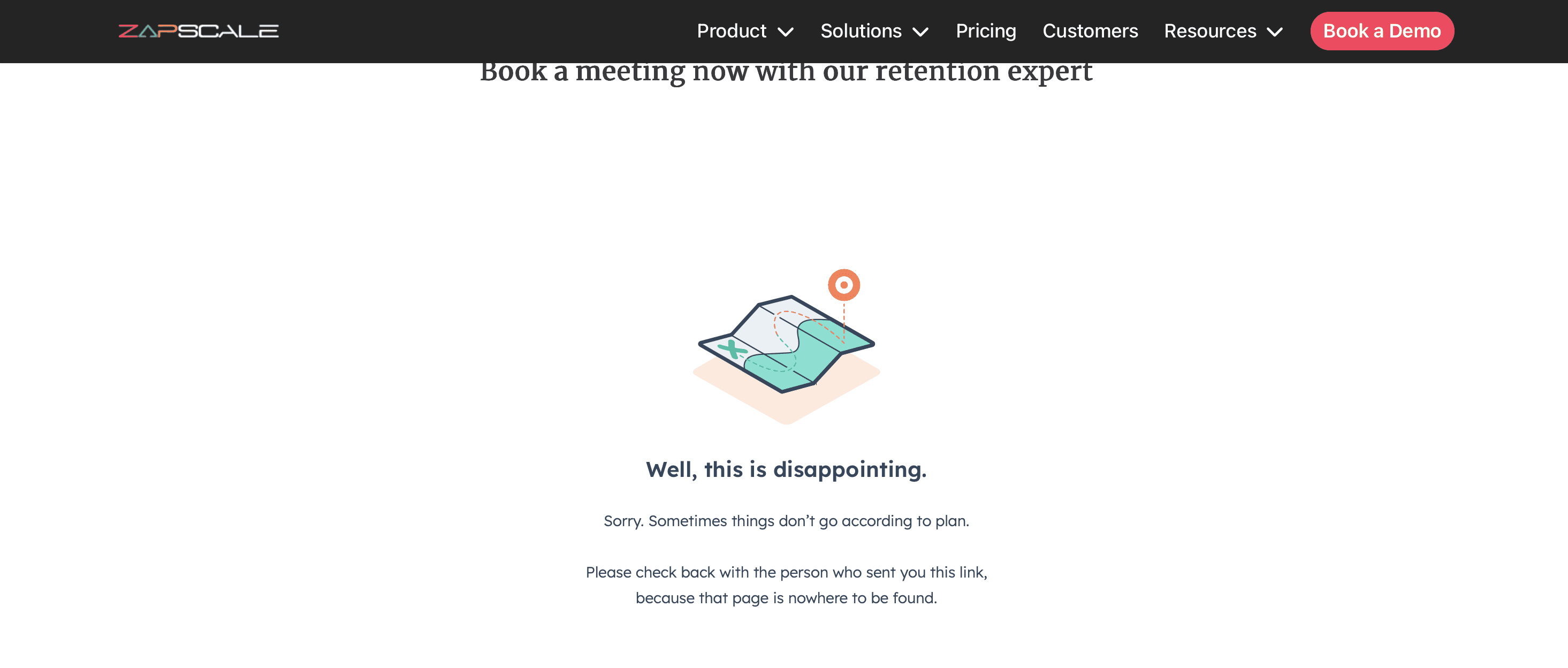
Concerning Signals: The demo request functionality on their website has been reported as non-functional, and recent employee departures may indicate organizational challenges that could impact product development and support.
Trigger Overload: Automated triggers can be unintuitive and sometimes generate excessive tasks, making it difficult for CSMs to prioritize effectively.
Limited Customization: For organizations with complex business models, customization and forecasting options may feel constraining.
Data Dependency: The platform's powerful analytics rely heavily on accurate data and clean integrations. Data quality gaps or integration issues can significantly reduce the value delivered.
Smaller Market Presence: As a less established player, some organizations may have concerns about long-term viability and continued product investment.
Ideal for: Small to mid-market companies prioritizing predictive analytics
Pricing: Available on request
Implementation time: 3-6 weeks
Final Thoughts
The success of any Customer Success Platform ultimately depends on having a strong owner within the CS team - typically a CS Operations professional—combined with robust support from Data Engineering and Analytics.
The platform is only as valuable as the data you feed it and the processes you build around it. Before selecting a tool, ensure you have clarity on your customer journey stages, health scoring methodology, and key success metrics. Starting simple with spreadsheets or lightweight tools while you refine these fundamentals will set you up for much greater success when you eventually graduate to a dedicated platform.
The CS platform landscape is ripe for disruption, particularly as AI capabilities mature beyond surface-level features. The platforms that will win in the coming years are those that truly embed AI agents into core workflows rather than simply adding chatbots as afterthoughts.